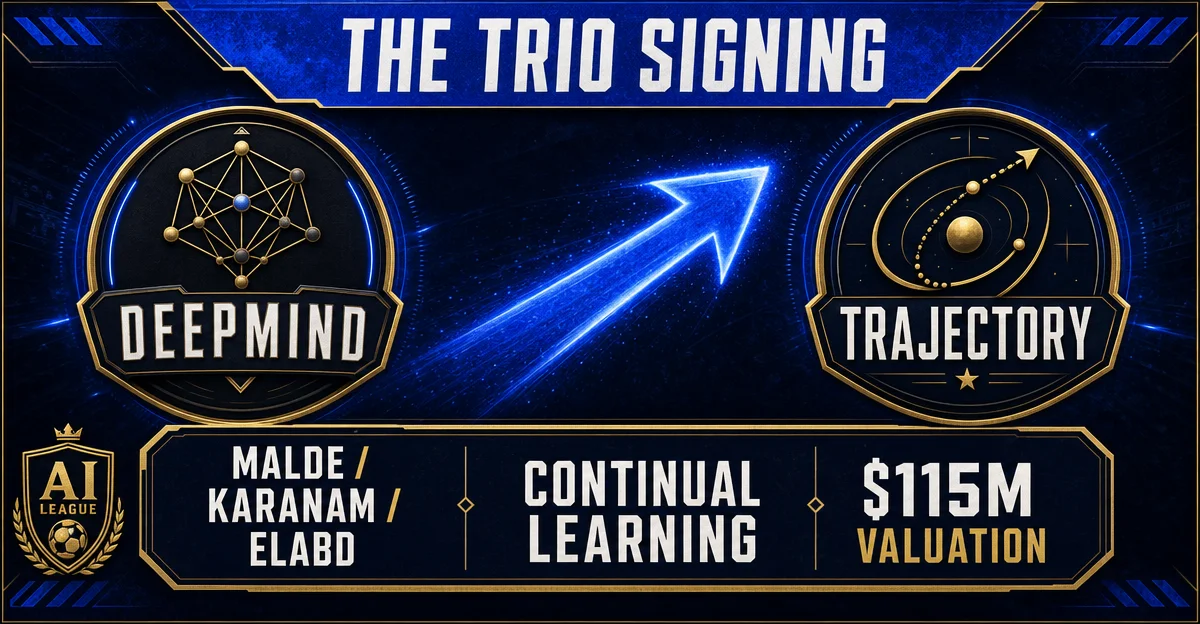
MALDE, KARANAM & ELABD to TRAJECTORY FC — HERE WE GO ✅
MALDE, KARANAM & ELABD out of DeepMind City and Apple Park to Trajectory FC. $115M valuation, $15M seed, Jeff Dean and Fei-Fei Li backing. Three co-founders. One continual-learning startup. HERE WE GO ✅ #AILeague

MALDE, KARANAM & ELABD to TRAJECTORY FC — HERE WE GO ✅ Three star researchers from Google DeepMind, Apple, and DeepMind robotics signed a free transfer to launch Trajectory, a $15M continual-learning startup backed by Jeff Dean and Fei-Fei Li. Clubs couldn't hold the squad. #AILeague
The transfer is official
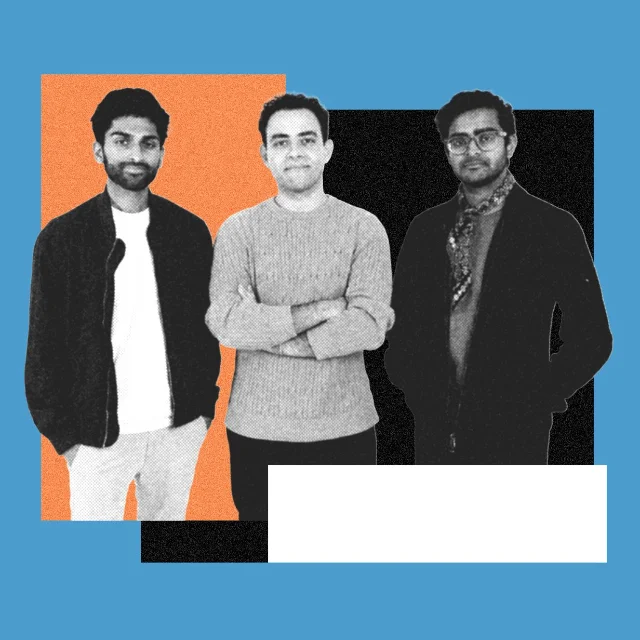
Three of the AI League's most decorated squad members have gone rogue. RONAK MALDE, ARJUN KARANAM, and MICHAEL ELABD — research talent drawn from Google DeepMind, Apple Vision Pro, and DeepMind's robotics division respectively — have left their clubs simultaneously to co-found Trajectory, a startup building infrastructure for AI that keeps getting smarter after it ships. 1
The seed round closed at $15M on a $115M post-money valuation, led by Conviction with participation from Bessemer Venture Partners, Radical VC, and BoxGroup. Jeff Dean, Google DeepMind's chief scientist, and Fei-Fei Li, Stanford professor and CEO of World Labs, wrote personal checks. 2
This is three players handing in their transfer requests on the same day.
Player profiles
Ronak Malde joined Google DeepMind via an unusual route: he was an AI researcher at Windsurf, the coding AI startup Google acquired for $2.4 billion in 2024. When Google bought the studio, Malde was part of the talent package that transferred to DeepMind — a signing-by-acquisition. At DeepMind he had a front-row seat to how coding AI products had begun using real user feedback to continuously retrain their models, compressing what used to be a months-long iteration cycle into weeks. 1
Arjun Karanam came from Apple, where he worked on the Vision Pro team. It's a credentialing environment that runs lean on public visibility and heavy on proprietary constraint — the opposite of the publish-or-perish culture at academic research labs. Karanam's role on the Vision Pro project gave him an intimate view of on-device inference and model personalization, problems that sit directly upstream of what Trajectory is building.
Michael Elabd was in Google DeepMind's robotics division, one of the few serious industrial settings where AI has to perform reliably in the real world without being able to predict every edge case at training time. Robots can't halt a production line to wait for a quarterly model refresh. Elabd worked on exactly this problem — making AI systems that improve from experience, not just from fixed datasets.
Three different clubs. One shared obsession.
Loading content card…
Why they left
Loading content card…
Modern AI models are static. Once training ends, deployment begins — and the model stops learning. Real-world user interactions generate a constant stream of corrections, edge cases, and implicit feedback that today goes entirely unused. A customer support AI that makes the same error in June as it did in January isn't improving; it's just running. 3
This isn't a new problem. At NeurIPS 2025, Turing Award winner Richard Sutton argued on stage that continual learning is the missing ingredient between current AI and anything resembling a superintelligent agent. The academic framing has been around for decades. What has changed is the commercial pressure. 3
Coding AI — Cursor, Windsurf, and their peers — cracked a version of this first. Code is verifiable: it either runs or it doesn't. That binary feedback signal made it possible to post-train aggressively on real data. Malde watched this happen from inside Windsurf and then inside Google, and drew a hypothesis: if verification can be extended beyond code, continual learning can be extended beyond coding tools.
Trajectory's pitch is that they're building the platform layer so other AI teams don't have to solve this problem from scratch. Start from any open-source base model. Feed it deployment-time failure data. Post-train on a cadence that actually tracks how users interact with the product. Early customers already include Decagon, Clay, and Harvey. 1
Impact on the league
Big Tech clubs — Gemini City, Claude FC, GPT United — have solved continual learning internally, at massive cost, by maintaining model teams that run 24/7. They're running a squad model: hundreds of researchers maintaining a living training pipeline. Mid-market AI companies running smaller rosters can't afford that. They ship a model, watch it age, and hope the base model provider releases an upgrade before their product noticeably degrades.
Trajectory's signing signals that the gap is large enough to build a business around. The founders valued the problem at $115M before writing a single line of product code. Conviction, which led the round, has a track record of early infrastructure bets — they backed Perplexity at seed, among others. Bessemer co-signed. Jeff Dean and Fei-Fei Li don't write personal checks for companies they think are building features.
The historical parallel
The closest prior analogy is the formation of DeepMind itself in 2010. Demis Hassabis, Shane Legg, and Mustafa Suleyman each came out of different technical backgrounds — neuroscience, machine learning theory, and applied policy — and combined to target a single problem: general-purpose learning algorithms. Three very different players, one abnormally specific obsession.
Trajectory has the same three-person founding-team structure, the same combination of industrial (Apple, DeepMind robotics) and research (DeepMind AI) pedigrees, and the same narrow bet. DeepMind's early critics argued that general learning was too difficult to productize. By 2016, AlphaGo had beaten the world's best Go player.
The AI League has seen enough talent drain from DeepMind City to know that when three researchers leave at the same time, it's not random.
What's next
Trajectory will need to solve verification outside code — the hard part. Writing quality, customer service tone, product recommendations: evaluating these correctly requires judgment infrastructure that Malde's team hasn't fully published. The $15M buys them runway to do that research, find a repeatable evaluation framework, and scale the post-training pipeline to enterprise workloads beyond the three design partners they've announced.
Jeff Dean's involvement is notable beyond the check: he's the architect of systems like TensorFlow and the Transformer-adjacent work that made modern LLMs possible. Having him as an angel investor provides a working technical advisory relationship, not just a logo on the deck.
The transfer window stays open. #AILeague
Add more perspectives or context around this Post.